What can you build with WordPress? From a brochure site to a B2B store
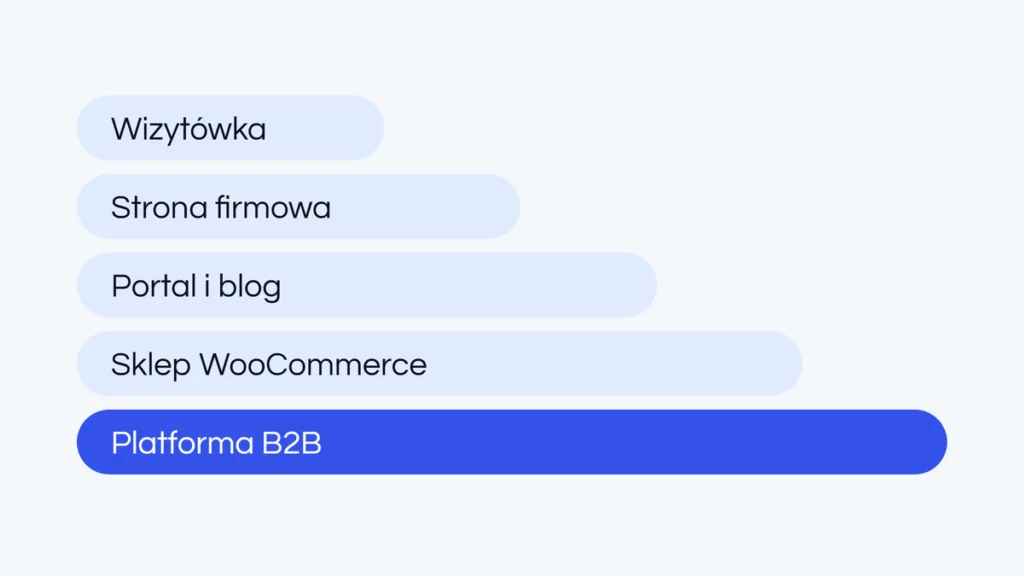
WordPress is still often seen as a blogging tool. In fact it powers everything from one-screen company pages to sales platforms serving thousands of business customers. According to W3Techs, it runs 39.5% of all websites and 58.2% of those whose content management system is known (checked on 2 November 2026). A shared engine does not mean shared difficulty, though: what is simple in a brochure site becomes a serious engineering project in a B2B store.
Below are the most common types: what decides whether each succeeds, which EU rules apply once you sell across borders, and examples from our projects.
Company websites
A company website is your business card online and often a client's first contact with you. It answers four questions: who you are, what you offer, who it is for and how to reach you. It usually has an About us page, services, a portfolio, testimonials and a contact form.
Loading speed, a clear structure and solid SEO decide whether anyone finds you and stays long enough to be convinced; design alone does not sell. There is also a legal baseline: the EU e-Commerce Directive requires an online business to show its name, address, contact details including email and, where it applies, its trade register entry. In Germany this is the Impressum required by § 5 of the Digitale-Dienste-Gesetz (DDG). Cookies other than strictly necessary ones need consent before they are set, so analytics usually comes with a consent banner.
From our projects: for the property buyer twojskup.pl we created the brand, the website and a valuation form in three steps instead of one long field. At olimpcatering.pl we combined a new design with a pricing module and a faster site after refactoring the code, and bladebrothers.eu is a two-language site with horizontal scrolling, built to a design by an external studio.
Portals and content sites
WordPress also suits portals that bring together articles, multimedia and sometimes user accounts. Such sites often grow faster than planned. As posts and visits multiply, data architecture and performance matter more than the look. A portal that ran smoothly with a hundred articles can slow down at ten thousand if it was not designed for scale.
From our projects: for totylkoteoria.pl we moved more than 1,000 articles from Blogger, added a new design and built a voting module for "Biologiczna Bzdura Roku" (Biological Nonsense of the Year), with results that can be exported to CSV.
Landing pages
A landing page is a single-screen site with one goal: a newsletter signup, a download or a purchase. Everything on it should lead to that action. It is about conversion, speed and consistency with the campaign: someone who clicked an ad for a specific offer must see exactly that offer, and in a campaign running in several countries, in their own language.
From our projects: a landing page with an interactive view of buildings and floors for the residential development aksamitnaresidence.pl, sales pages for the courses mesjaszyoga.com and vetclinicalnutrition.academy, and contest and offer pages with a promotion countdown for props.com.pl.
WooCommerce online stores
With the WooCommerce plugin, WordPress becomes a full store: products, cart, payments, shipping and taxes. With a few dozen products, many companies launch one on their own. Scale changes everything: with thousands of SKUs, product variations, stock synchronization and several sales channels, real engineering begins, and the architecture decides whether the store handles traffic or falls apart whenever orders spike.
Selling to consumers across the EU adds two topics. VAT: once your cross-border sales to EU consumers exceed EUR 10,000 a year, you charge each customer's national rate, which you can declare in one member state through the One Stop Shop (OSS). WooCommerce can hold rates per country, but someone must keep them current. Accessibility: since 28 June 2025, the European Accessibility Act, applied through national laws such as Germany's BFSG, has covered online shops selling to consumers. Microenterprises providing services (fewer than 10 employees, turnover or balance sheet up to EUR 2 million) are exempt.
From our projects: at fitcookie.co.uk we rebuilt the store front for performance and conversion and connected it to BaseLinker, courier companies and a review system. For karolinaholda.com we built an English version of the course store with advanced product filtering, and for wydawnictwosam.pl we simplified the purchase path and added a bundle configurator.
B2B platforms and integrations
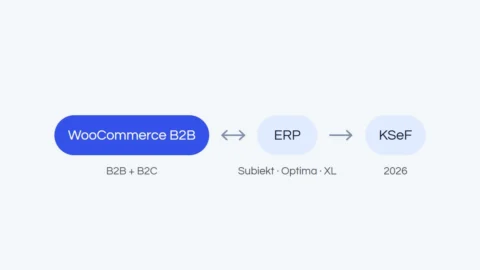
The most demanding case is a B2B platform: customer-specific price lists, company verification at registration and synchronization with an ERP (SAP Business One, Microsoft Dynamics 365 Business Central, Odoo or, in Poland, enova), a PIM or a CRM. WordPress works well as the front end that customers and staff find comfortable, but the heart of the project is the data flow between systems.
In the EU, verification has a tax side: when you sell goods to a business in another member state, you do not charge VAT if the customer has a valid EU VAT number, so the store should check it in the European Commission's VIES service and keep a record of each check for tax inspections.
This is no longer "putting up a website" but building a system, and it is where a cheap implementation differs most from one that genuinely removes manual work. More in our articles on B2B stores for manufacturers and wholesalers and on WooCommerce ERP integration.
From our projects: ecotexgroup.com is a wholesale B2B store in Polish and English, with prices in złoty and euro, and kalvei.cz synchronizes with the ERP in real time, verifies companies in the Czech ARES register on its own and generates XML files for trading partners.
Custom platforms
The most interesting projects fit none of these boxes. WordPress can be extended with custom modules, so the tool is shaped around the business.
From our projects: lapis-gold.pl is a configurator for made-to-measure stone products, with live pricing and a PDF production sheet, running as three stores for Poland, Germany and Austria. domkamienia.pl is a closed B2B exchange for the stone industry where only verified companies see prices and contacts, and 4skill.pl is a camp and training platform for two brands, with a camp module and an offer template. WordPress also handles appointment booking: see our article on law firm websites in Europe.
Multilingual and multi-currency sites
Selling across Europe usually means several languages. Plugins such as Polylang or WPML give each language its own URLs, content and search descriptions in one dashboard. For Google, the versions should point to each other with hreflang tags, or the tags are ignored. Currencies are a separate layer: WPML's WooCommerce add-on, for example, shows prices in several currencies, set by hand or from exchange rates.
Under the EU Geo-blocking Regulation, you may not redirect a customer from another EU country to a different country version of your site because of where they live, unless they explicitly agree, and the version they chose must stay accessible. A clear language switcher is the safer design.
From our projects: gp-renewables.energy runs in four languages (Polish, English, German and French), with micro-animations and project subpages.
Moving a site to WordPress
Often the starting point is a site on static HTML, Blogger or an abandoned CMS. Moving to WordPress lets you tidy up content, speed things up and gain a comfortable dashboard, as long as every old URL gets a permanent (301) redirect to its new address, as Google recommends, so you keep your rankings.
From our projects: we moved marafiki.pl from HTML, JS and CSS to WordPress, together with its Instagram, Cloudflare and MailerLite integrations, and totylkoteoria.pl from Blogger, as described above.
Blogs and expert sites
With an intuitive dashboard, mature SEO support and simple publishing, WordPress is still one of the best tools for a blog or an expert site. For many companies this is the cheapest long-term way to win clients, as useful content draws search traffic for years. When you write for several countries, a separate text for each market usually beats a literal translation.

Choose for the goal, not the trend
WordPress can carry all of these, but "the same WordPress" looks completely different under the hood for a brochure site and for a B2B platform. The difference lies in the architecture, the integrations and the first decisions.
That is why we first establish what the site needs to do and how it should grow, and only then choose the tools. Picking a trendy solution first is the easiest way to overpay for something that does not fit. More on what goes into such a project in our article on professional WordPress development.
Frequently asked questions
Can WordPress handle a large store or a B2B platform?
Yes, if the architecture and integrations are designed for scale. With thousands of products and an ERP, it is an engineering project.
Can I build a WordPress site in several languages and currencies?
Yes. Each language gets its own URLs and content, and a WooCommerce store can show prices in several currencies.
How much does a WordPress website cost?
With us, a company website starts from EUR 1,000 net and a WooCommerce store from EUR 3,000 net. Custom platforms are quoted after a short conversation.
Can I move my site from another system to WordPress?
Yes, for example from static HTML or Blogger. The key is moving the content and setting up redirects, so you keep your positions in Google.
Not sure which type of site fits your needs? Request a free quote: a 30-minute conversation is usually enough to assess it and suggest a sensible direction. You can also see how we approach WordPress and WooCommerce projects.