E-invoicing for WooCommerce stores in Europe: KSeF, Peppol and ViDA
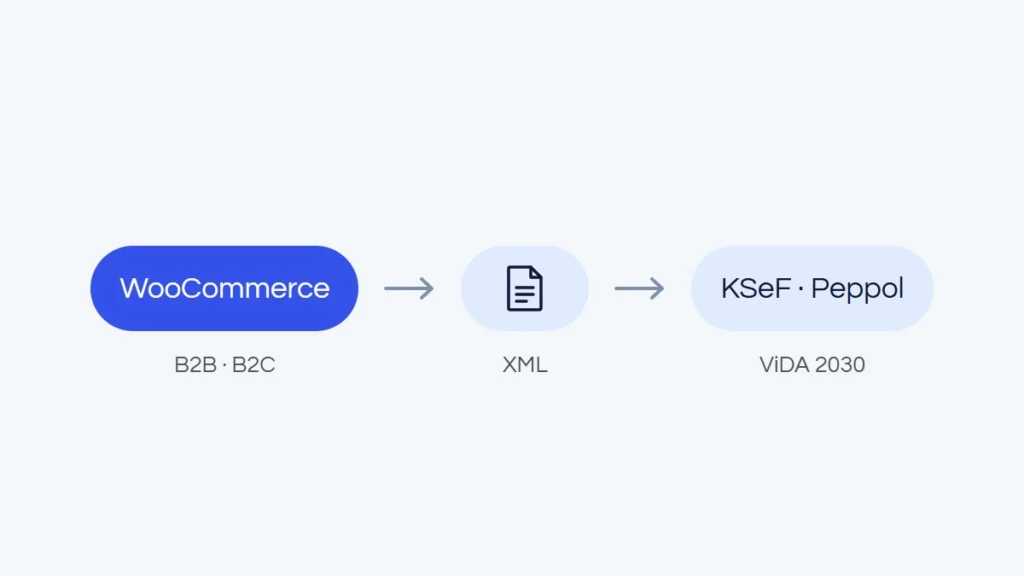
For years, an invoice from an online store was a PDF attached to an order email. Across Europe that is changing. More and more countries require structured e-invoices between businesses, sent through a national platform or a network such as Peppol, and from 2030 the EU makes them the rule for cross-border B2B sales too. If your WooCommerce store sells to other companies, this affects you sooner than you might think.
Below we explain what e-invoicing means for a WooCommerce store, where it already applies, how to connect the store and what to check before your first structured invoice goes out. Legal status as of 3 November 2026.
What an e-invoice is (and why a PDF is not one)
An e-invoice in the sense of the new rules is not a PDF. It is a structured file, usually XML, that the buyer’s software can read without retyping anything. The common reference is the European standard EN 16931, which the EU adopted for invoices in public procurement and which national formats such as Peppol BIS Billing, XRechnung or Factur-X build on. Poland uses its own structure (FA(3)) in its national system, KSeF.
There are two main models. In a clearance model, such as KSeF in Poland, every invoice goes through a government platform, gets an official number and only then reaches the buyer. In a network model, such as Peppol in Belgium, the invoice travels directly from the seller’s software to the buyer’s software through certified service providers. Either way, the store itself rarely talks to the tax authority: the invoicing software or the ERP does.
Where it already applies
Since 14 April 2025, EU member states may require e-invoices for domestic transactions without asking Brussels for permission, and several already do:
- Poland: invoices between businesses go through KSeF. It has been mandatory since 1 February 2026 for the largest companies and since 1 April 2026 for the rest, with a transition period for the smallest sellers until the end of 2026.
- Belgium: since 1 January 2026, VAT-registered businesses established in Belgium must send and receive structured e-invoices over the Peppol network. A PDF by email is no longer a valid B2B invoice. We cover the details in our article on B2B online stores for manufacturers and wholesalers.
- Germany: since 1 January 2025, businesses established in Germany must be able to receive e-invoices based on EN 16931 (for example XRechnung or ZUGFeRD). Issuing them becomes the rule from 2027, or from 2028 for businesses with a prior-year turnover of up to EUR 800,000.
- France: since 1 September 2026, all businesses must be able to receive e-invoices, and large and mid-sized companies must issue them. Smaller businesses follow on 1 September 2027.
At EU level, the VAT in the Digital Age package (ViDA, Council Directive (EU) 2025/516) makes structured e-invoices the rule for cross-border B2B transactions from 1 July 2030, together with digital reporting to tax authorities.
B2B and B2C orders
The mandates above are about invoices between businesses. Invoices to consumers are mostly outside them: Belgium explicitly excludes sales to private individuals, and in Poland invoices to consumers may be issued in KSeF voluntarily but do not have to be. For a store selling to both, the practical question is simple: does the order come from a business, and from which country?
That is why the checkout matters. A business customer needs a clear “buying as a company” option, a VAT number field and complete company details. For EU customers, check the VAT number in the European Commission’s VIES system: it confirms the number is valid for intra-EU transactions, and for many invoice types it decides how VAT is charged.
Three ways to connect WooCommerce
WooCommerce does not send e-invoices on its own. Something has to create the structured file, send it to the right platform or network, receive the confirmation and handle corrections. In practice there are three routes.
1. Invoicing software connected to the store
This is the most common setup in our projects. The store passes the order to invoicing software that already supports the country’s system (KSeF, Peppol or another), and the software issues the invoice when the order reaches a chosen status. Once e-invoicing is configured in the software, this runs automatically. It suits stores that do not issue invoices in an ERP.
2. Invoices from the ERP
If sales and stock are managed in an ERP, the invoice can be created where the warehouse documents are. The ERP needs an e-invoicing connection for your country and an API the store can use to pass the order and read the invoice status. This is a good route when the store is one of several sales channels. We describe the data exchange in our guide to WooCommerce ERP integration.
3. A custom integration
When a ready-made connection does not fit your process, for example invoices only after shipping from several warehouses or corrections that must follow specific returns, a custom integration connects the store with the ERP or the invoicing software. A direct connection from WooCommerce to a national platform or a Peppol access point is technically possible, but then the store would have to handle authentication, formats, outages and every change in the rules. We avoid that: we connect the store to software that has e-invoicing built in and keeps up with the regulations.
What to check in your store
- Company data at checkout. A separate VAT number field (not a note), checked for format and, for EU customers, in VIES. An invoice issued to the wrong company cannot simply be withdrawn.
- One trigger, one invoice. Decide which order status creates the invoice (paid or completed) and make sure it happens only once. A duplicated event means two invoices and a correction.
- Corrections and returns. In mandatory systems an issued invoice cannot be deleted, only corrected. In Poland, the official KSeF manual says so directly. A refund in WooCommerce should therefore trigger a credit note or at least a task for accounting.
- Consistent data. Prices, VAT rates, rounding, shipping costs, coupons and currencies must match between the store and the invoice. Format checks do not catch a wrongly calculated amount.
- Who issues what. One system, the invoicing software or the ERP, should be clearly responsible for each invoice. Two systems issuing in parallel is a recipe for duplicates.
Test before you go live
Test the whole flow on a copy of the store, with invoicing switched off or in test mode. National systems often offer their own test environments: Poland’s Ministry of Finance runs a test and a pre-production Demo version of KSeF in which invoices have no legal effect. In a network like Peppol the opposite risk applies: a test invoice sent from a live account lands directly with a real customer.
Test at least these cases: a consumer order, a business order with a valid VAT number, a wrong VAT number, a full and a partial return, a cancelled order after payment and a foreign customer. We describe how we test integrations in how we design ERP integrations.
Checklist
- You know which system issues invoices, and that it supports e-invoicing in each country where you have to.
- Checkout has a clear company option, a VAT number field and complete company details.
- One defined status triggers the invoice, without duplicates.
- Returns and order changes trigger credit notes.
- Tests ran on a copy and, where available, in the official test environment.
- Your accountant has confirmed how consumer invoices are handled.
Frequently asked questions
Do invoices to consumers have to be e-invoices?
Mostly no. The current national mandates focus on invoices between businesses. In Poland, consumer invoices may be issued in KSeF voluntarily.
I sell to Belgian or German companies from another EU country. Do I need their systems?
Not as a legal obligation for now. Belgium’s rules cover businesses established in Belgium, and Germany’s obligation to receive e-invoices applies to businesses established in Germany. Your customers there may still prefer structured invoices, and from 2030 ViDA makes them the rule for cross-border B2B sales anyway.
Can WooCommerce send e-invoices directly?
Technically it can be built, but we do not recommend it. Invoicing software or an ERP with e-invoicing built in handles authentication, formats, outages and legal changes for you.
How we can help
E-invoicing in an online store is mostly about data: what the store passes on decides whether the invoices are correct. We connect WooCommerce with invoicing software and ERP systems, and when a ready-made connection is not enough, we build a custom integration. Sending to the e-invoicing system stays with the software that has it built in. An integration usually takes 2-4 weeks from the decisions to launch, we quote it after a short conversation, and ongoing monitoring is part of our maintenance package. See our ERP, PIM and CRM integrations or request a free quote.