B2B webshop for manufacturers, wholesalers and industry: what it needs
Many manufacturers and wholesalers still take orders by email, by phone or through sales reps who retype them into the system by hand. That works while you have a few dozen customers. With hundreds of accounts, thousands of SKUs and individual price lists, you get mistakes, delays and phone calls asking “is this in stock?”.
A B2B online store (in the Netherlands and Belgium usually called a B2B webshop) solves this, but only if it is built around the way businesses buy. A trade customer does not browse banners or hunt for deals. They know their part numbers, order regularly and have their own prices and payment terms. Below we describe what a B2B store needs, what different industries require and when WooCommerce is enough.
How a B2B webshop differs from a regular online store
A regular online store is built for retail customers: one price for everyone, a cart, online payment and courier delivery. A B2B store, also called a B2B ecommerce platform, has to handle many more trade rules.
- Customer-specific prices and discounts. Each account or customer group sees its own prices, often pulled straight from the ERP system. On top of that, volume discounts and deals for selected customers only.
- Company accounts. Registration with a VAT number, company verification before prices are shown, several users per company (for example, a buyer places the order and a manager approves it) and delivery addresses for different branches.
- Payment terms. Bank transfer with deferred payment, credit limits and a view of open invoices. Online payment is often an extra, not the default.
- Quantities and units. Minimum order quantities, sales in bulk packs (carton, pallet) and unit conversion, for example square meters to full packs.
- Quick ordering. Entering SKUs with quantities, importing a list from a CSV or Excel file, repeating a previous order and saved shopping lists.
- Availability and lead times. Stock levels from the warehouse (often several warehouses) and a real delivery date, not just “in stock”.
- Documents. Invoices, delivery notes, technical data sheets, certificates and declarations to download from the customer account.
- Request for quote. For made-to-order products, the customer sends a request instead of using the cart, and a sales rep replies with an offer.

B2B store, ERP and e-invoicing
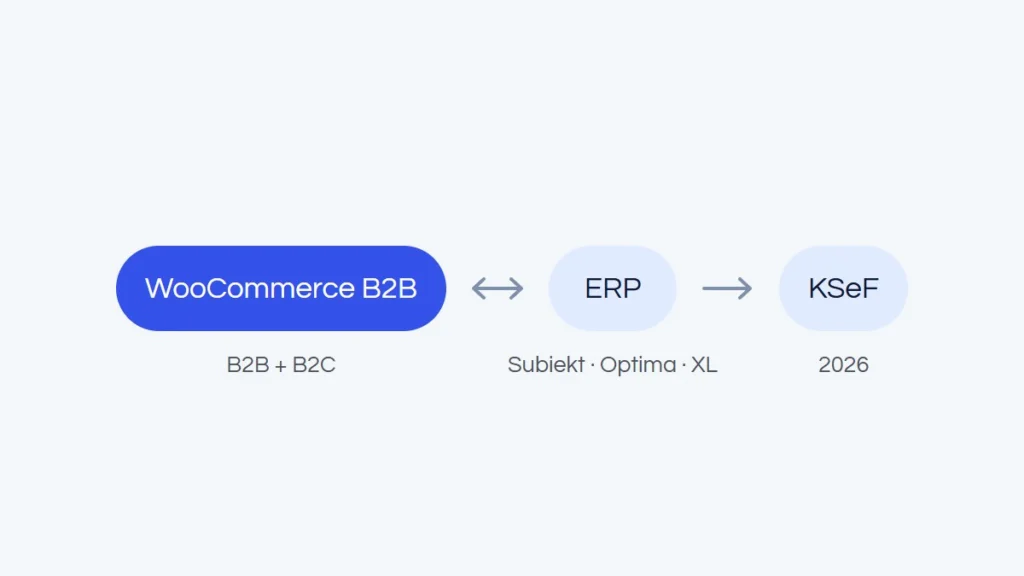
At a manufacturer or wholesaler, the ERP system is usually the source of truth for products, prices and stock. A B2B store should use it, not duplicate the data: products, customer prices and stock flow from the ERP to the store, and orders go back to the ERP without retyping. We write about planning this data exchange in WooCommerce ERP integration: what really works and what doesn’t.
E-invoicing is becoming mandatory across Europe. In Poland, invoices between businesses go through the national KSeF system since 2026, in Germany businesses have had to be able to receive e-invoices since 2025, and in Belgium structured e-invoices between businesses are mandatory since 2026 (more below). The store usually does not send invoices to the tax system itself: the ERP or invoicing software does, after it receives the order from the store. That is why correct company data at checkout (VAT number, name, address) and a consistent data exchange matter so much. A handy extra is letting customers download invoices straight from their account.
Belgium: Peppol e-invoices between businesses since 2026
If you run a wholesale or B2B webshop in Belgium, this already applies to you. Since 1 January 2026, VAT-registered businesses established in Belgium must send and receive structured e-invoices for sales to other businesses. The default is the Peppol BIS Billing 3.0 format, delivered over the Peppol network. A PDF sent by email is no longer a valid B2B invoice in Belgium: it can only travel alongside the structured one. Sales to consumers are not covered.
- Who is covered. Almost every VAT-registered business established in Belgium, including those using the small business VAT exemption. Businesses that make only VAT-exempt supplies (article 44 of the Belgian VAT Code) and those on the flat-rate scheme are outside the obligation. Foreign businesses without a Belgian establishment are currently excluded.
- Fines. Not being able to send or receive structured e-invoices costs EUR 1,500 the first time, EUR 3,000 the second time and EUR 5,000 after that. The first three months of 2026 were a tolerance period, but only for businesses that could show they had started preparing in time.
- What comes next. Belgium plans near real-time reporting of invoice data to the tax authority (e-reporting) from 2028; the law is still a draft. At EU level, the ViDA package brings e-invoicing and digital reporting for cross-border B2B sales from 1 July 2030.
For a WooCommerce store this changes little at checkout and a lot behind it. The invoice still comes from your ERP or invoicing software, which now has to work with Peppol, and the store has to pass it complete company data, including a valid VAT number. The free government tool Hermes, which some small businesses used for occasional invoices, stopped sending and receiving at the end of 2025, so they also need a Peppol service provider now.
What different industries need
The B2B basics are the same everywhere, but each industry has details that decide whether customers will actually want to order online.
Building and finishing materials
The goods are large and heavy, so delivery cost depends on weight, volume and zone, and some orders go by pallet freight or the company’s own trucks. Selling by the square meter requires conversion to full packs. Customers often pick up goods at a chosen branch, so stock at a specific warehouse matters.
Spare parts, machinery and tools
Search is the key: by catalog number, manufacturer number, replacements and the machine model the part fits. With large catalogs, exploded-view drawings help, where the customer clicks a component and sees its part number right away. Agricultural machinery parts add seasonality, so the store has to handle the seasonal peak.
Electrical, automation and installation supplies
Thousands of SKUs from many manufacturers mean product data has to be imported and cleaned up in bulk, for example from a PIM system or supplier files, often using the ETIM classification standard. Prices are usually a discount off the list price, and customers order by manufacturer part numbers.
Chemicals, cleaning products and safety equipment
For hazardous products, safety data sheets have to be provided to professional customers, so it is best to have them on the product page and in the order history. Some goods have shipping restrictions. Customers buy the same products on a regular cycle, so shopping lists and repeat orders work well.
Made-to-order products and components
Often there is no catalog price at all. Instead, a configurator (dimensions, material, finish) with automatic pricing works well, or a request for quote with an option to attach a technical drawing. Instead of stock levels, the customer sees the lead time and minimum batch size.
Is WooCommerce a good fit for a B2B webshop?
Yes, with one caveat: core WooCommerce is built for retail. It has no customer-specific price lists, no company accounts with multiple users and no quick ordering by SKU. These features come from B2B plugins or custom development, and in practice usually a mix of both.
A few things speak for WooCommerce:
- no license fees tied to the number of users or revenue, and full ownership of your data,
- one store for trade and retail customers (B2B and B2C), with different prices and views after login,
- ready integrations with popular ERP systems, payment providers, couriers and marketplaces,
- freedom to grow: a configurator, a panel for sales reps or a PIM integration is a matter of project scope, not platform limits.
There are limits too. With very large catalogs (hundreds of thousands of SKUs) and prices calculated separately for every account, WooCommerce needs a good server, well-planned caching, fast search and a well-designed ERP sync. If your ERP vendor offers its own B2B module that covers your processes, compare it with WooCommerce before you decide. We cover platform choice in How to choose a platform for your store or website, and what else this engine can do in What can you build with WordPress.
How to plan a B2B webshop rollout
- Talk to your sales reps. They know best how customers order today, what they ask about and where mistakes happen. The store should take work off the sales team, not compete with it, so it helps when a rep can also place an order on a customer’s behalf.
- Source of truth for data. Decide where products, prices, stock and customer data come from (ERP, PIM, supplier files) and which way orders, invoices and statuses flow.
- First version. Login and company accounts, customer prices, quick ordering and orders that land in the ERP. Without these, a B2B store makes no sense; everything else can wait.
- Pilot. Start with a few regular customers who will give honest feedback before everyone sees the store.
- Growth. Configurators, quote requests, a panel for sales reps, marketplace sales and automation, in the order the data suggests, not the wish list.
Frequently asked questions
Can one store serve both trade and retail customers?
Yes. A retail customer sees regular prices and pays online, while a logged-in company sees its own prices, payment terms and B2B features.
Do prices have to be visible to everyone?
No. The store can work as a product catalog for visitors who are not logged in, and show prices and ordering only after login and company verification.
Do I need an ERP system for a B2B store?
Not always. A smaller wholesaler can start with a store connected to invoicing software that handles e-invoicing. With thousands of SKUs and individual price lists, an ERP as the data source makes life much easier.
I sell to Belgian companies from another EU country. Do I need Peppol?
Not as a legal obligation for now. The Belgian rules cover businesses established in Belgium, and foreign businesses without a Belgian establishment are currently excluded. Your Belgian customers must be able to receive Peppol invoices, though, so if your invoicing software supports Peppol, sending invoices that way is an easy option.
How long does a rollout take?
It depends on the number of integrations and custom features. A simple B2B store with order integration is built much faster than a platform with a configurator, several warehouses and real-time price sync. We give a specific timeline after a short review of your processes.
We design and build B2B stores on WooCommerce together with ERP, PIM and courier integrations. See how we build WooCommerce stores and our ERP, PIM and CRM integrations, or describe your industry and how you sell in the free quote form.