Page builders and widgets: why they make starting easier and growing harder
Page builders did something good for WordPress: they let non-technical people build a site on their own without touching code. Elementor, WPBakery, Divi and similar builders work on a “drag and drop” basis, and you see the result right away. No wonder they became the default choice for many beginners and for agencies that want to deliver fast and cheap.
The problem is that what speeds up the start often slows down everything that comes after. Builders solve the problems of the first week and create problems that surface over the next two years. It is worth understanding this trade-off before you build something on them that is meant to last.
Where the convenience comes from
A visual editor gives you instant feedback: you move an element, change a color, add a section and immediately see the result. For someone who doesn’t know HTML or CSS, that is a huge change, because the site stops being a black box. This immediacy is real value, and there is no point denying it.
The thing is, this convenience doesn’t come from nowhere. To let you arrange elements freely on the screen, the builder has to generate a huge amount of generic code under the hood that can handle every possible scenario. And that code is the source of the trouble later on.
The price performance pays
A site built with a page builder loads far more code than a site written for a specific project. Nested containers, extra stylesheets and scripts loaded “just in case” add up to a weight the browser has to download and process on every visit. The result is slower loading, worse scores in performance tests and lower Core Web Vitals ratings.
This is not a purely technical problem. Loading speed today directly affects your Google ranking and conversion, because some visitors leave before the page even appears. A nice layout that loads three seconds slower can cost you real customers, and you won’t see that at first glance in the dashboard.
How builders block the way forward
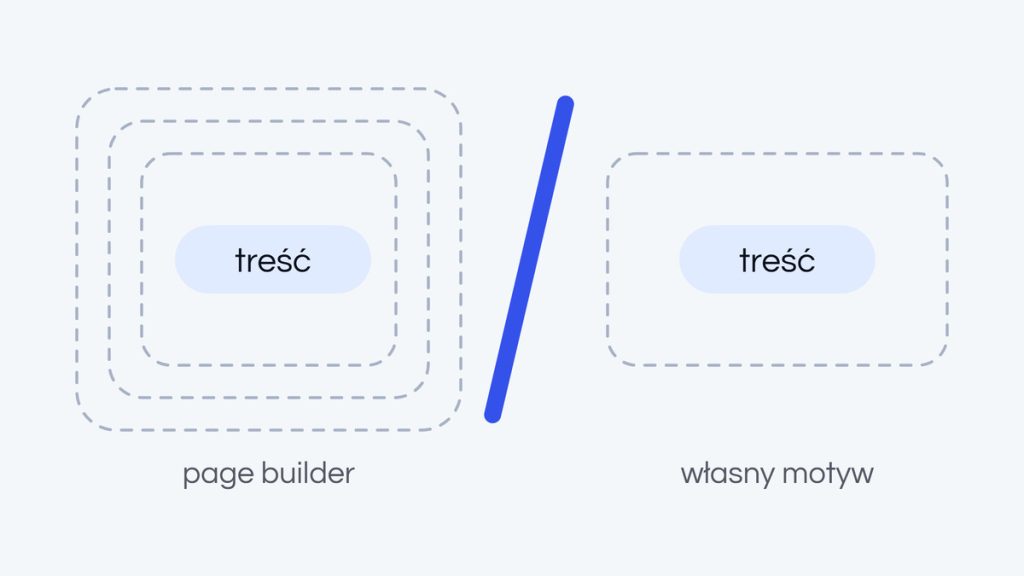
The second, less obvious cost is lock-in. The content and layout of a site built with a particular builder are tightly intertwined with it. When you want to switch it off or change the theme, it often turns out that the content falls apart into a mess of unreadable markup, and the site practically has to be rebuilt from scratch.
Then there is the snowball effect: you add a missing feature with another plugin, then another, until the project becomes a tower of blocks where every change threatens a collapse. The longer such a site lives, the harder and more expensive it is to make even a small modification. Development that was supposed to be simple turns into carefully working around limitations.
Technical debt you can’t see in the demo
All of this adds up to technical debt: the hidden cost of decisions made “for now.” In the demo the site looks great, the client is happy and the problem is asleep. It wakes up at the first serious change, migration or traffic spike, when it turns out the foundation was not designed for growth.
The worst part is that technical debt grows quietly. There is no single dramatic moment when something breaks; there is a series of increasingly expensive “small fixes,” until it finally becomes simpler and cheaper to rebuild the site than to keep patching the old one.
When a builder is a good choice and when it isn’t
This is not a manifesto against page builders. For a simple landing page, a temporary campaign or a project with a very limited budget, a visual editor can be a reasonable, deliberate compromise. If the site is meant to live for a few months and doesn’t have to fight for every hundredth of a second of loading time, a builder will do the job.
It is different when the site is meant to be the foundation of a business for years and has to be fast, highly visible in Google and ready to grow. Then lightweight, purpose-built code pays for itself many times over, because it delivers performance, security and freedom to make changes. We build so that the code can be maintained and developed, including by someone else, with no magic plugins and no builders in the critical layer.
Have a page builder site that is slowing down or holding back growth? Get in touch, and we will assess whether optimization is enough or whether a solid foundation is the better investment.