What can you build with WordPress? From a brochure site to a B2B store
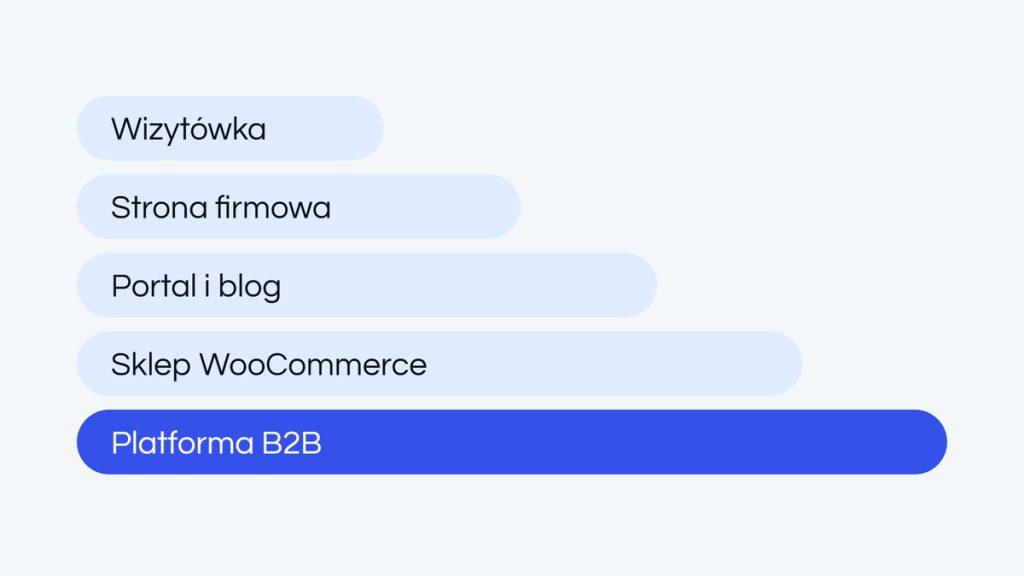
For years, WordPress was associated mainly with blogs, and that association still lingers. Yet today it is a mature platform used to build very different kinds of websites, from single-screen brochure sites to complex sales platforms serving thousands of business customers. A shared engine does not mean shared difficulty, though: what looks simple under the hood for a brochure site becomes a serious engineering project for a B2B store.
Below we walk you through the most common types of sites built on WordPress. For each one, we look not only at how it looks, but above all at what really determines its success, because that second layer is what most often gets missed when you only look at ready-made templates.
Company websites
A company website is a business’s calling card online and usually the first serious point of contact with a potential client. It answers four questions: who you are, what you offer, who it is for and how to get in touch. Typical elements include an About us section, a description of services or products, a portfolio, testimonials and a contact form.
Although it looks like the simplest case, a well-made company website has its own requirements. Loading speed, a clear structure and correct SEO matter, because all of this affects whether anyone finds you at all and whether they stay long enough to be convinced. Aesthetics are important here, but on their own they don’t sell.
Portals and content sites
WordPress also works very well for large portals that aggregate different kinds of content: articles, multimedia, sometimes user accounts or community sections. A site like this is often aimed at a specific audience (an industry, a region or a topic) and often grows much faster than planned at the start.
And this is where the real challenge appears. As the number of posts and visits grows, the look takes a back seat, and data architecture and performance come to the fore. A portal that ran great with a hundred articles can start slowing down at ten thousand if it was not designed with scale in mind from the start.
Landing pages
A landing page is a single-screen site with one clearly defined goal: a newsletter signup, a download or the purchase of a specific product. Everything on it should lead the visitor to that one action, and everything that distracts works against it.
That is why a landing page is above all about conversion, speed and consistency with the campaign that sends the traffic. If someone clicked an ad for a specific offer, they need to see exactly that offer, with no unnecessary distractions. This is “less is more” in its purest form.
WooCommerce online stores
With the WooCommerce plugin, WordPress turns into a full-fledged store: with products, a cart, payments, shipping and tax handling. With a few dozen products, launching such a store is relatively simple, and many companies manage it on their own.
Scale changes everything, though. With thousands of SKUs, product variations, stock level integration and multiple sales channels, real engineering begins. This is the point where the choice of architecture and the way the store connects to the rest of your systems decide whether the site can handle the traffic or will fall apart every time orders spike.
B2B platforms and integrations
The most demanding case is B2B platforms: with price lists assigned to specific business customers, company verification at registration and synchronization with ERP, PIM or CRM systems. WordPress works very well here as the front-end layer that both the client and the team find comfortable to work with, but the heart of the project is no longer the look; it is the flow of data between systems.
This is no longer “putting up a website” but building a system in which several independent tools have to talk to each other consistently and reliably. This is where you most often see the difference between an implementation done on the cheap and one that genuinely takes work off the company’s plate and eliminates manual, repetitive tasks.
Blogs and expert sites
Finally, back to the roots: WordPress is still one of the best tools for running a blog or an expert site. An intuitive dashboard, mature SEO support and simple publishing make building reach with content feel natural, with no technical back office required.
For many companies, this is the cheapest long-term way to win clients. Regular, valuable content works for you for years, drawing search traffic long after you publish it.
Choose for the goal, not the trend
WordPress can handle every type of site described here, but “the same WordPress” looks completely different under the hood for a brochure site and for a B2B platform. The difference is not in the logo on the login screen but in the architecture, the integrations and the decisions made at the very beginning.
That is why, before we start a project, we first establish what the site actually needs to do and how it should grow, and only then do we choose the tools. Doing it the other way around (first a trendy solution, then a search for a use for it) is the easiest way to overpay for something that doesn’t fit.
Not sure which type of site fits your needs? Get in touch: a 30-minute conversation is usually enough to assess it and point you in a sensible direction.